✍️ LargestCharities Editorial Team|🩺 Fact-checked against American Red Cross guidelines|🗓 Last updated: May 2026
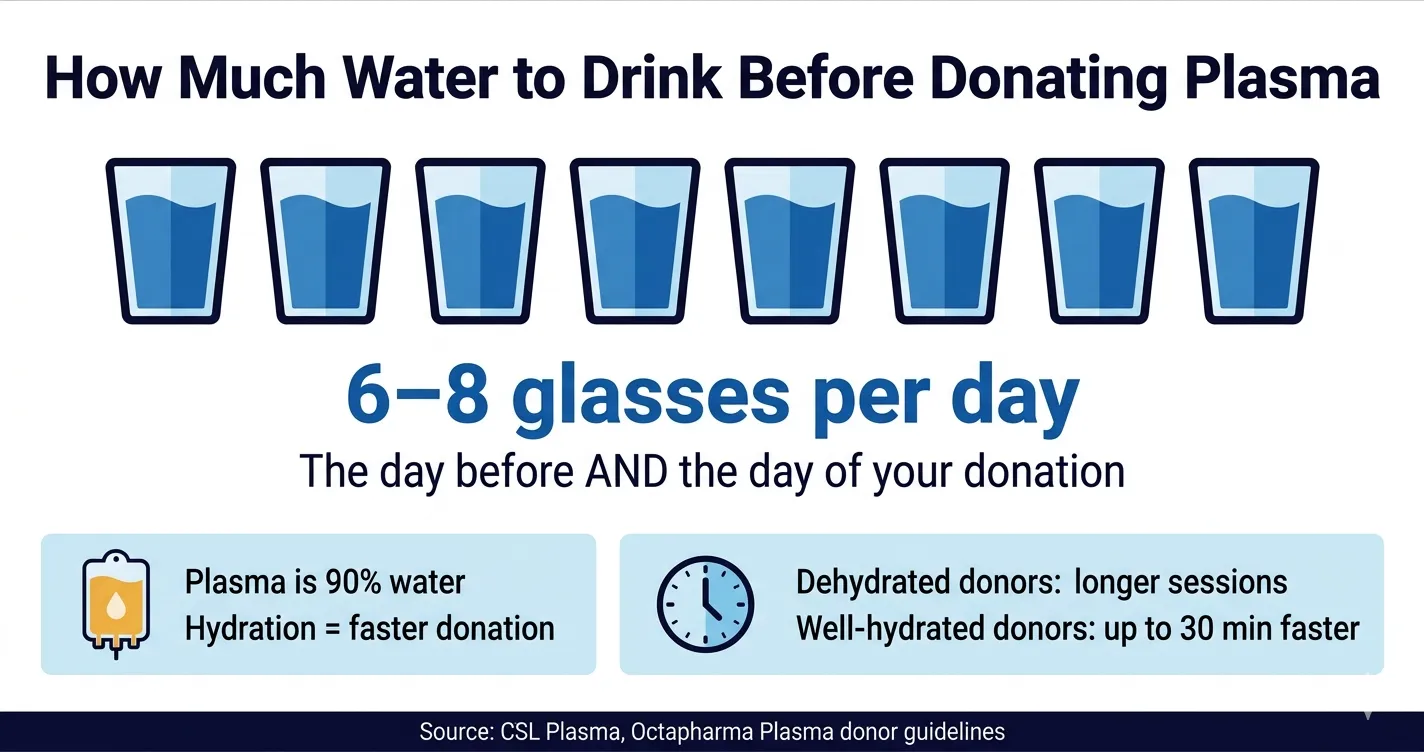
Plasma donation centers consistently recommend 6–8 glasses (48–64 oz) of water the day before and the day of your appointment. That's more than what whole blood donation guidelines specify — because plasma is roughly 90% water, and hydration directly determines how fast and smoothly your donation goes.
Plasma Donation Hydration Guidelines
Day before donation: 6–8 glasses of water (48–64 oz) — CSL Plasma guideline
Day of donation: Another 6–8 glasses, spread throughout the morning
After donation: Continue drinking extra water for the rest of the day
What counts: Water, juice, sports drinks, herbal tea — avoid alcohol and limit caffeine
Key check: Urine should be pale yellow to clear before your appointment
Why Hydration Matters More for Plasma Than for Blood
Plasma is more than 90% water. When you give plasma, the plasmapheresis machine draws your blood, separates the liquid plasma component, and returns your red blood cells to your body mixed with sterile saline. The quality and flow rate of that plasma is directly tied to how hydrated you are.
Well-hydrated donors experience faster donation times — sometimes significantly faster. CSL Plasma specifically notes this in their donor preparation materials: "Some donors have told us that when they focus on hydrating, they experience a faster donation." Dehydrated plasma is more viscous, moves slowly through the collection system, and can sometimes appear cloudy, which may affect how it's processed.
There's also the session length factor. Plasma donation takes up to two hours — much longer than a whole blood draw. During that time, your body is continuously cycling blood through the machine and receiving your returned cells. Starting that process dehydrated and spending two hours in a chair while losing fluid progressively is a recipe for side effects at the end of the session.
Dehydration has specific, predictable effects on the plasma donation process:
Slower draw time. Thicker blood moves slowly through the tubing and machine. A donation that should take an hour can extend considerably.
Harder vein access. Dehydrated veins are smaller and more prone to rolling. Multiple needle attempts are more common.
More pronounced citrate reaction. The citrate added to prevent clotting during the process can cause tingling in the face, hands, or feet. This reaction is more common and more intense when donors are dehydrated.
Dizziness and lightheadedness after donation. Your blood pressure drops when you stand up after losing plasma volume, and a dehydrated starting point makes that drop more pronounced.
Timing Your Water Intake
The biggest mistake is drinking a lot of water immediately before showing up. Your body doesn't instantly move water from your stomach into your bloodstream and veins. Start the evening before. If your appointment is in the morning, drink extra water throughout the day before and continue the morning of. If your appointment is in the afternoon, you have more time, but the same principle applies: spread your fluid intake over hours, not minutes.
Many regular plasma donors say they judge their hydration by urine color: pale yellow to clear is the target. If urine is still dark yellow the morning of your appointment, you need more time and more water — or you'll feel it during the session.
What to Drink Before Plasma Donation
Water is optimal. Fruit juices are acceptable — orange juice is particularly useful because vitamin C helps iron absorption, which matters for maintaining the hemoglobin levels you need to pass pre-donation screening. Sports drinks with electrolytes are fine and can be useful if you find plain water difficult to drink in quantity. Avoid alcohol for 24 hours (a diuretic that directly causes dehydration) and limit caffeine (also a mild diuretic).
Avoid fatty foods in the same hydration window — they don't affect hydration, but high fat content can cause lipemia (cloudy plasma) that makes your donation unusable.
Frequently Asked Questions
How much water should I drink the morning of a plasma donation?
At least 2–3 glasses (16–24 oz) in the morning before your appointment, on top of what you drank the evening before. Don't try to drink it all at once right before you walk in — spread it over the hours of your morning. Show up already hydrated rather than trying to catch up in the waiting room.
Does being hydrated make plasma donation faster?
Yes, meaningfully so. Well-hydrated donors have better blood flow through the plasmapheresis machine. Some regular donors report that their donation time drops by 20–30 minutes when they're well-hydrated compared to days when they weren't. This matters when a session can run up to two hours — hydration is one of the few variables you directly control.
Can I drink too much water before plasma donation?
At the amounts relevant to donation preparation — a few extra glasses — no. Drinking excessive amounts very rapidly (gallons in a short time) could theoretically cause hyponatremia (water intoxication), but this is not a realistic risk from following donation preparation guidelines. Drink your extra water spread over several hours and you're fine.
Sources: CSL Plasma donor preparation guidelines (cslplasma.com); Octapharma Plasma nutrition guide; GoodRx Health plasma donation guide (updated Feb 2026). For informational purposes only — not medical advice.