✍️ LargestCharities Editorial Team|🩺 Fact-checked against American Red Cross guidelines|🗓 Last updated: May 2026
Donating blood takes about 30 minutes from needle in to juice box. Most problems — dizziness, slow recovery, being turned away — come down to a handful of simple things people skipped. This is a complete checklist covering before, during, and after, based on American Red Cross guidelines.
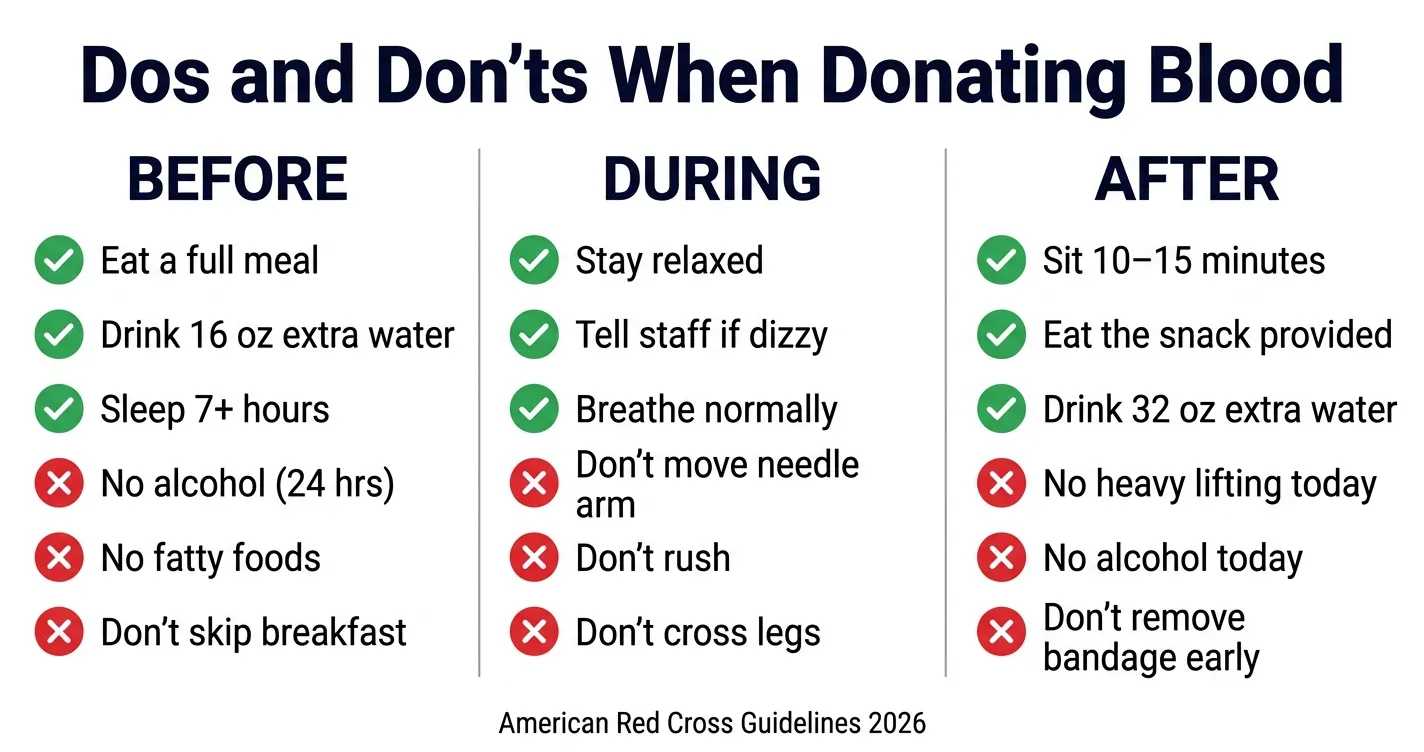
Based on American Red Cross Guidelines 2026
Before Donation — What to Do
✓ Do
Eat a meal within 2–4 hours of your appointment. Iron-rich foods are best: red meat, chicken, fish, beans, spinach, iron-fortified cereal. Don't donate on an empty stomach.
Drink an extra 16 oz (2 cups) of water before your appointment, on top of your normal daily fluid intake. Hydration is the most reliable way to prevent side effects.
Get at least 7 hours of sleep the night before. Fatigue makes side effects more likely.
Bring a valid photo ID and your donor card if you have one. First-time donors will need ID.
Wear a shirt with sleeves that roll up easily past your elbow. Short sleeves or loose long sleeves work best.
Tell staff about all medications you're taking — prescription and over-the-counter. Most don't disqualify you, but staff need to know.
Pair iron-rich foods with vitamin C to improve absorption. Orange juice with breakfast, or tomatoes with your beans.
Complete your RapidPass online (Red Cross) before your appointment to speed up the intake process.
Before Donation — What to Avoid
✗ Don't
Don't drink alcohol for at least 24 hours. Alcohol dehydrates you, lowers blood pressure, and slows recovery from fluid loss after donation.
Don't eat fatty foods — fries, pizza, burgers, donuts, fried chicken. High fat content can make your blood untestable for infectious diseases, which means it gets discarded.
Don't skip the meal. Donating on an empty stomach is the most common cause of dizziness and fainting.
Don't take aspirin for 48 hours before donating if you're giving platelets. Aspirin affects platelet function. This restriction applies to platelet donation specifically — not whole blood.
Don't show up if you're sick — fever, active infection, sore throat. You'll be turned away, and waiting until you're fully recovered protects both you and recipients.
Don't donate if you've gotten a tattoo or piercing within the past 3 months (varies by state — check with your center).
During the Donation — What to Do
✓ Do
Stay relaxed. Tension and anxiety make veins harder to access and can trigger vasovagal reactions (the lightheadedness-then-fainting sequence). Deep, slow breaths help.
Tell staff immediately if you feel dizzy, nauseous, or faint. This is the most important thing you can do during a donation. Staff can recline your chair, elevate your legs, and stop the draw before you have a problem. They've seen it before. Say something early.
Pump your fist gently if the phlebotomist asks you to. This helps blood flow. Don't do it aggressively or continuously without being asked.
Breathe normally throughout the draw. Some people hold their breath without realizing it.
Look away if needles bother you. Nobody at the donation center will judge you for not watching.
During the Donation — What to Avoid
✗ Don't
Don't move the arm that has the needle. Movement can dislodge the needle or collapse the vein, which ends the donation and may bruise badly.
Don't cross your legs. Crossing your legs can affect blood flow and blood pressure during the draw.
Don't ignore early signs of feeling faint. Waiting until you're actively passing out is much harder to manage than speaking up when you first feel warm or lightheaded.
Don't be in a rush. If you tell staff you need to leave quickly, they can sometimes accommodate, but trying to rush through a blood donation is a recipe for side effects.
After the Donation — What to Do
✓ Do
Sit in the recovery area for 10–15 minutes before standing up. Your blood pressure needs time to normalize after donation. This is not optional politeness — it's why the recovery area exists.
Eat the snack and drink the provided beverage before you leave. This stabilizes blood sugar and starts fluid replacement.
Keep the bandage on for 4–5 hours. If the needle site bleeds, apply firm pressure with the bandage and elevate your arm.
Drink an extra 4 cups (32 oz) of fluids in the 24 hours after donation.
Eat well for the rest of the day. Continue iron-rich foods to help your body rebuild hemoglobin.
Tell someone you donated if you're going somewhere alone afterward, especially if you drove. If you feel faint while driving, pull over immediately.
After the Donation — What to Avoid
✗ Don't
Don't do heavy lifting or vigorous exercise for the rest of the day. Your body is redistributing fluid and the needle site needs time to close properly.
Don't drink alcohol for the rest of donation day. Your blood pressure is already lower than usual from fluid loss. Alcohol compounds this and slows recovery.
Don't stand up quickly from the recovery chair. Orthostatic hypotension — the dizziness from standing up fast — is much more pronounced after blood donation.
Don't remove the bandage too soon. Four to five hours minimum before taking it off. If the site is still tender, leave it longer.
If you feel faint after leaving the donation center: Sit or lie down immediately. Elevate your legs if possible. Do not try to walk it off or push through it. If you're in a car, pull over before you do anything else. Call 911 if symptoms don't improve quickly.
Eligibility Don'ts — Things That May Disqualify You
Beyond the preparation guidelines, certain conditions and activities affect whether you can donate at all. The Red Cross maintains a full eligibility list, but common disqualifiers include:
Recent travel to malaria-risk countries (check wait periods by country)
Pregnancy or recent childbirth (wait 6 weeks postpartum)
Recent tattoo or piercing at an unregulated facility
Certain medications (most are fine — ask your center)
Low hemoglobin on the day of donation (below 12.5 g/dL for women, 13.0 for men)
Blood pressure outside the acceptable range at time of donation
Frequently Asked Questions
What should I wear when donating blood?
Wear a shirt where the sleeves can be easily rolled up above your elbow. Short sleeves are the most practical. Avoid tight long sleeves — rolling them up is uncomfortable for 30 minutes and can restrict circulation. Comfortable clothes overall are better because you'll be sitting or lying down for a while.
Can I donate blood if I have a cold?
No. If you have a fever, active infection, or feel unwell on donation day, reschedule. Donating while sick isn't safe for you and could compromise the donation. Most centers ask you to wait until you've been symptom-free and off antibiotics before donating.
How long does blood donation take?
The actual blood draw is about 8–10 minutes for whole blood. With intake, screening, the draw itself, and the 10–15 minute recovery period, plan on about an hour total for your first visit and 30–45 minutes for subsequent donations.
Sources: American Red Cross blood donation guidelines (redcrossblood.org); University Health blood donation FAQ; Healthline. For informational purposes only — not medical advice.